I have spent years sitting in rooms full of intelligent people, listening to them explain artificial intelligence badly.
Not stupid people. Capable, well-paid people running companies and selling products. And every time the question came up — “how does the AI work?”, “where is the AI?”, “what are you doing with AI to make it better?” — the answer was some variation of smoke, mirrors and a confident tone of voice.
So I’m writing a book. Actually, I’m writing five. The first is AI for Normal People: Understanding Artificial Intelligence Without the Hype, and this is the story of why it exists, how I’m making it, and why I’d like you to know when it lands.
The moment it tipped over
As a CTO, part of my job is being responsible for how AI gets explained and how it actually gets used, across the platform and the infrastructure underneath it. When investors ask what we’re doing with AI, somebody has to give them an answer that’s true.
My day job gives me a front-row seat to the other side of the industry: slapping an “AI” label on anything that can be sold. Machine learning? AI. A workflow with three if-statements? Believe it or not, also AI. Meanwhile, more and more people were climbing aboard the hype train and trying to educate me on how AI was going to revolutionise everything, how we could lift-and-shift people’s work onto it and all become smarter, more efficient workers overnight.
Child, sit down.
My PhD thesis was in AI and machine learning, including LLM tooling for producing structured, iron-clad legal documentation. I know what AI is, and most of what’s in the news, the ads and the keynotes isn’t it. At its core, AI is a prediction system. A remarkably good one — but a prediction system.
The moment it actually tipped over was watching a senior executive I work with field a question about AI in front of an investor. They weren’t bad at explaining things. They just didn’t have the foundation to steer the conversation away from smoke and mirrors and back to sticks and stones. Nobody’s fault — and exactly the problem.
Right, I thought. I’m writing this book. And I’m making it a series, so I can cover every base properly instead of competing with YouTubers who insist you drop everything today because yesterday is already obsolete. Really? Then why aren’t you flying around in a solar-powered car? Fuel and wheels are so yesterday.
Why a book
This has been in my head for twenty-odd years, in notes, research and half-thoughts. Turning it into the first three proper chapters still took the best part of a year, because the thing that stopped me before is what stops everyone: time.
I’ve got a blog, a YouTube channel and no shortage of opinions, so why a book? Because blog posts are fragments. You can follow everything I publish and still end up with a pile of disconnected pieces. A book keeps it together, in order, something you can come back to and search. And once it’s printed, it’s printed. Any academic, researcher or average Joe can pick it up and tell me I’m wrong, and I can’t quietly edit it afterwards. That’s exactly why it’s worth doing.
When I announced it, Johnny gave me the look you get when you “discover” something everyone else worked out ages ago: “Yeah, of course you should. Haven’t you already written a book anyway?”
Thanks, love.
I’ll admit I was nervous. I’ve been the living Google for a lot of people on a lot of subjects — a bit like Serie, the ancient elven living grimoire in Frieren — but saying things in a meeting and putting your name on a printed book are very different kinds of accountability.
Who “normal people” are
The title isn’t an insult. Okay, it’s a little bit of a jab.
A normal person, for this book, is anyone who’s had five or six years of AI rhetoric fired at them from the left, right, up, down and round and round, and would like to know what’s actually true. The carer who wants grounded information. The person who thinks their favourite YouTuber just handed them the keys to the industry. The person who’s avoided the whole thing, got confused, and wants to know not just what it is but how to use it — sensibly, and without an arm and a leg in monthly subscriptions.
It’s also for a few people in senior technology roles I’ve worked with who could do with a reality check. No names.
Before writing the new version, I sat down for coffee with anyone willing and asked them to explain AI to me in their own words, using whatever helped. Nearly all of them used AI to explain what AI was — and they still couldn’t get it across clearly.
That changed the whole book. I’d planned to start with readers who roughly knew what AI was. It turns out most don’t — and that isn’t their fault. Almost nobody has explained it to them properly.
The two big misunderstandings
I hear two claims more than any others: that AI thinks, understands and relates to you like a human would, and that AI is going to take all our jobs.
Both are no.
Electricity was going to take our jobs. So was the steam train. So were robots. If something were really about to take all our jobs, I wouldn’t be writing this — I’d be on my spaceship heading to the rings of Saturn for the weekend.
I fucking wish.
What I see from the inside is less science fiction and more ordinary corporate behaviour. “AI” gets used as cover — for offshoring, restructuring, or squeezing more out of fewer people — with a $20-a-month subscription handed over as the magic ingredient that’s supposed to make up the difference. Then everyone acts surprised when the overall output drops.
If you’ve ever been stuck in a loop with an AI tool — make the text bigger, move the box left, too far, back a bit, darker blue, actually can we change the logo — you’ve felt a small version of this. It isn’t a colleague who understands you. It’s predicting what you probably want. That’s useful. It isn’t magic.
The hype, in both directions
“Without the Hype” isn’t decoration.
On one side there are the ads promising you can just describe an app and it springs to life, as if security, testing, content rights and deployment are optional extras. On the other are the doom interviews, where speculation arrives with the emotional weight of evidence and ordinary AI failures get stretched into proof that catastrophe is already underway. If you want to worry about who’s steering the AI narrative, start with the companies and executives with the most money riding on it. AI isn’t sentient. Maybe one day. Not today.
And now there’s the hangover. After years of executives overselling AI, plenty of people have swung hard the other way — “AI slop”, “workslop”, it’s useless. The strategist Alexander Braun has argued that the internet has gone into full “it’s useless” mode, driven by headlines about failed corporate pilots. Jean Lee shared a meme that nails it: AI according to the news is Ex Machina taking over the world. AI in real life is asking whether a butterfly is a pigeon.
Both extremes are wrong. The book lives in the middle, where the useful stuff is.
This book exists because too many people are making decisions about AI based on people who profit from either frightening them or exciting them.
Not a rewrite — an assembly
People ask whether I’m “redoing” Book 1. It’s hard to rewrite something you haven’t written yet.
The first attempt looked like Albert Einstein’s desk: post-it notes across every notebook I own, random Markdown files, saved links, Google Docs, Word docs and a few GitHub repos I’d hidden from myself. Having enough material for a book turned out to be very fucking different from having written one. Turning that pile into something another human can read from start to finish, without needing access to my brain, was the real job.
The plan also grew from three books to five. I regularly criticise management for giving someone thirty days to learn a departing colleague’s job, while expecting six months of training for any new hire. Three books was me doing exactly that to my readers. I’d rather spread it out and let people go at their own pace.
Why a PhD is writing the beginner book first
You don’t start a PhD by writing your thesis and then go back and sit your entrance exam.
Book 1 is the least technical book in the series on purpose. It gets my biggest audience on the same page before we level up together. The simplifications are choices, not gaps — and some of them physically hurt. Calling a modern language model “fancy autocomplete” is like calling a space shuttle a glorified skateboard because they both have wheels. The pedant in me twitches every time. But for someone starting from zero it’s a far better first step than a lecture on architectures, and the book is honest about where the metaphor breaks.
The chapter that fought me hardest wasn’t technical. It was Chapter 11, AI Hype vs Reality. How the technology works has a clear blueprint. Hype doesn’t — it’s a moving target made of psychology, marketing and emotion. We describe AI with human words like “thinking” and “understanding”, and then I have to tell readers it does neither in the human sense. Add an audience that wants either a sentient saviour or a useless plagiarism machine, and you’re arguing with feelings, not facts.
So I lean on metaphors and radical honesty. My favourite is the eager intern: it has read more than any person ever could, types at ridiculous speed, desperately wants to please you, and has no life experience or common sense. When it doesn’t know the answer, it will confidently make something up to keep you happy. You’d never let that intern run your company unsupervised. You’d absolutely let them draft your emails.
The biggest thing I’ve learned is how much context I carry around without noticing. Something feels obvious after decades in technology, and then I try to explain it from zero and discover six concepts underneath it that I assumed everyone knew. Writing for beginners isn’t easier than writing for engineers. It’s harder, because you can’t hide behind jargon.
Writing a book about AI, with AI
Right. The obvious question.
I’m writing this book. That distinction matters.
It would be pretty fucking weird to write a series called How To Use AI.com without using AI, and it’s heavily involved. But it isn’t writing chapters while I wander past and approve them. I decide what I want to say, what I believe and how to explain it. I read every word, and every word published under my name is there because I decided it should be.
What AI gives me is something a solo author simply couldn’t have until recently: a team around the desk at all hours. Researchers, critics, editors, fact-checkers, and the occasional argumentative little bastard to bounce ideas off.
For research, I send it off with a chapter plan to find papers, primary sources, official documentation, real examples and — most importantly — credible views that disagree with mine. I don’t want twenty sources that all agree with me. Finding the strongest opposing view quickly is where it has saved me the most time. The sources are kept, so I can go back to the original, verify it and decide what’s useful.
For editing, I use it as something to argue with. Is this clear? Did I contradict myself? Am I assuming something a beginner doesn’t know? Is that claim supportable? I use ChatGPT, Claude and Codex deliberately, because I don’t have to accept the first model’s opinion. It’s remarkably handy having an editor available at ridiculous hours who never tires of me saying, “No, that’s not what I fucking mean,” and is happy to look at version seventeen.
For production, the manuscript, research, diagrams and every decision live in a version-controlled repository, run like a software project, with decision records, open issues and a changelog. Brilliant or deranged? Probably both. But a Word document gives me a document, and I’m building a product: five books, covers, a website, a preview edition. AI helps turn my words into the finished thing — typesetting, diagrams, covers, PDFs, validation. The output is heavily automated. The content isn’t.
Where the line is
AI does not get final authority over anything in this book. I do.
It doesn’t decide what I believe. It doesn’t get to invent facts, quotes, statistics or sources, and it certainly doesn’t get to invent my personal experiences — it doesn’t have any. It doesn’t get to sand my writing down until I sound like the terms and conditions for a dishwasher, or make it more complicated just because it knows longer words.
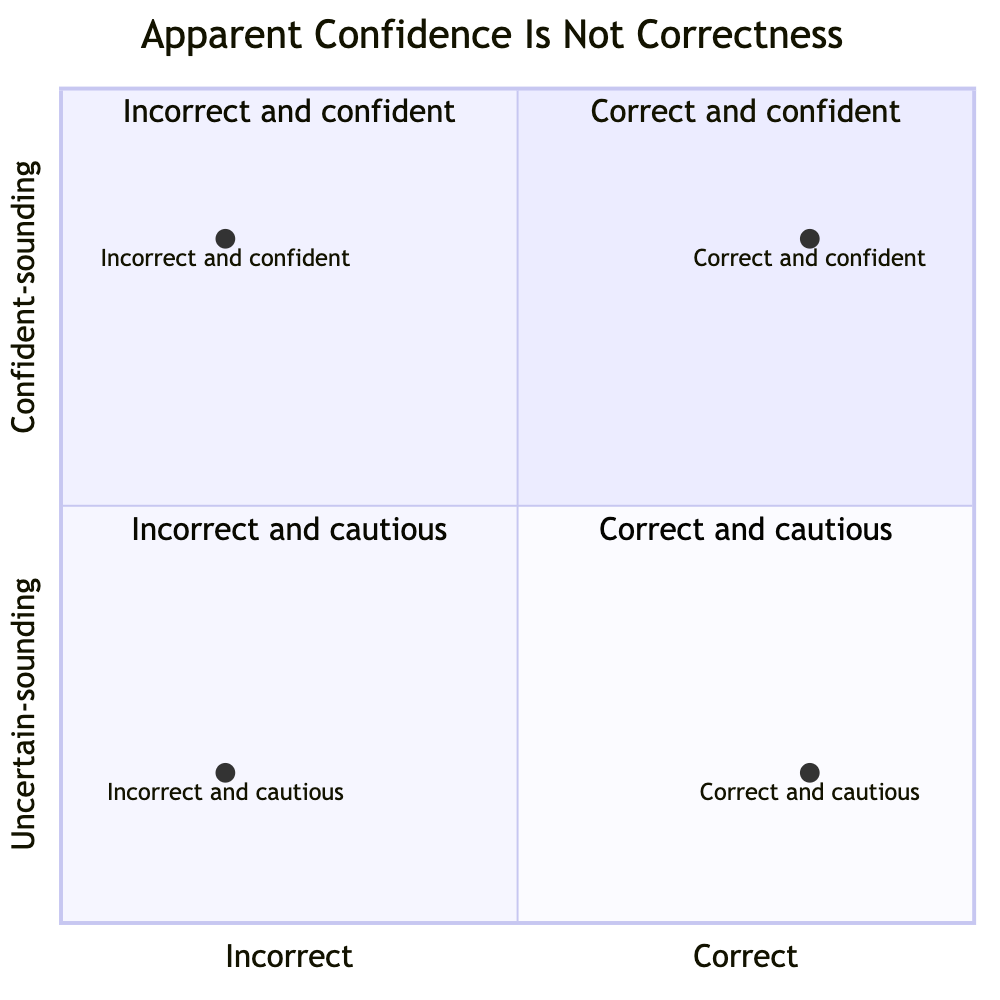
Most importantly, I don’t treat confidence as evidence. That diagram above is from Book 1, and I live it every day. These systems invent context, assume what I meant, turn nuance into absolutes, and produce polished paragraphs that sound fantastic until you actually read them. The funniest part of the whole project has been asking AI to help write a book explaining that AI doesn’t understand things, and watching it misunderstand what I asked. Tell it “do not invent anything here” and you can practically watch it think: you know what this needs? A completely fictional anecdote.
Worse than being wrong is agreeing with me too easily. I don’t need a cheerleader. I need something that tells me when my argument doesn’t hold up.
Is it ironic to write a book about not trusting AI blindly, with AI? No — that’s the whole point. I’m not telling people not to use AI. I’m telling them to understand what they’re using. I use it constantly, and I still question it, verify it, argue with it and reject it.
Research, editing and production can all be accelerated. Responsibility can’t be outsourced. If something in this book is wrong, I don’t get to say “the AI wrote it.” I published it. It’s mine.
AI gets a voice. It doesn’t get a vote.
What’s actually in Book 1
Fourteen chapters across four parts, ending with an epilogue called Don’t Panic. It starts with what most people don’t realise — you’ve been using AI for years — and moves through what AI can and can’t do, how to talk to it properly, how it fits at home, at work and in creative work, the problems nobody should ignore, jobs, hype versus reality, and where it goes next.
Before Book 1, AI feels like magic, a threat or marketing noise. After it, you can use it for real work, recognise its limits, check what it gives you, spot a bullshit claim, and make calmer decisions about it.
The example that makes it click is your bank’s fraud detection. Your card gets used in Sydney, then in Singapore twenty minutes later. Nobody needs to “understand” that emotionally. The system sees the pattern is impossible, compares it with your normal behaviour at a scale no person could manage, and flags it fast enough to matter. Pattern recognition at scale. No magic required.
The chapter I’m proudest of is Chapter 4, What AI Cannot Do, because it stops the book turning into a cheerleading pamphlet. Convincing output isn’t truth, understanding, judgement or responsibility. If you only read one chapter, read that one. The one people will argue with is Chapter 10, on jobs — and the answer is less comforting and more useful than either camp wants: some tasks will go, many roles will change, and people who learn to use AI well will usually beat people who refuse to engage.
What I deliberately left out is “The 20 Best AI Tools of 2026”. It’d be stale before the ink dried. The book teaches you to judge tools, not to be loyal to this month’s winner.
Something to try tonight: pick one annoying, low-stakes task you already understand — an awkward email, a meal plan, a messy to-do list. Ask an AI tool to help. Give it context, say what a good result looks like, and treat the first answer as a draft to improve. That’s it. Stop being scared of pressing the button, and stop believing the answer just because it sounds confident.
The five-book on-ramp
Three books wasn’t enough without either skipping things or cramming. I don’t want to throw a dictionary of technical terms at someone who knows nothing and pretend I’ve educated them.
The promise: start at Book 1 knowing absolutely nothing, and by the end of Book 5 you should understand enough to design and build real AI systems — with no mysterious gap where I suddenly assume you learned something elsewhere.
- AI for Normal People — understand it. What AI is, what it isn’t, and how to use it sensibly.
- Practical AI Workflows & Productivity — use it. Put AI to work in repeatable personal and professional workflows.
- AI for Business & Operations — operationalise it. How organisations should use AI without turning everything into an AI-labelled shitshow.
- Building AI Systems & Automation — build it. Integrations, automation and actual working systems.
- AI Engineering & Architecture — engineer it. Reliable systems, infrastructure, architecture and trade-offs.
You don’t have to read all five. The point is that there’s a path if you want one — for the person who starts out using ChatGPT to write an email and eventually thinks, “Hang on, how does all of this actually connect together?”
Technical people can skip Book 1. I’m not their mother. But plenty of people who understand how a transformer works have still swallowed a remarkable amount of industry nonsense about what AI understands and what it can replace.
And because AI changes every few months, the books are built on concepts, limitations and ways of thinking that survive product launches. The fast-moving material — tool examples, corrections, updates — lives on how-to-use-ai.com. Print gives the subject structure. The website keeps the edges alive.
The scary bit
My biggest fear isn’t people disagreeing with me. Disagree away. It’s being wrong in print — publishing confident bullshit in a book specifically warning people about confident bullshit.
Imposter syndrome shows up too, PhD or not. Not as “I don’t know anything about AI”, but at the moment you make knowledge permanent and public and say, “Here — I think this is worth your time and money.”
It has cost me mainly time. An obscene amount of it. It turns out “write a book” actually means “accidentally start a small publishing company”: research, sources, covers, ISBNs, print sizes, metadata, legal bits. The day it felt real was generating the cover and seeing Book 1 of a five-book series — a PDF that looked like a book rather than a folder full of my latest mental episode. Oh. Oh, fuck. I’m actually doing this.
If nobody buys it, I’ll be annoyed, and then I’ll probably keep going anyway. Of course I want people to buy it — I’m not doing ISBNs because I secretly hope nobody notices. But twelve copies wouldn’t make AI less interesting or the series less worth finishing.
What I actually want out of this
Money, legacy, reputation, teaching and a little bit of spite. Never underestimate how productive I get when someone confidently explains my own field to me incorrectly.
But mostly teaching. Success a year from now is emails from people who finally understand AI after avoiding it for years, who’ve stopped being terrified of it, or stopped believing everything it says. It’s seeing a stranger reading a copy I didn’t personally hand them. That would be weird and excellent.
The message that would make it all worth it: “I thought AI wasn’t for me. I read your book, understood it, tried it, and now I know enough to make my own decisions about it.”
Underneath that is the bigger point. I want people to stop outsourcing their judgement — not just to AI, but to CEOs, YouTubers, LinkedIn prophets, vendors, doom merchants and whichever billionaire got interviewed this morning. Understand AI well enough that nobody can steer your opinion just by sounding confident.
Use it. Enjoy it. Build things with it. Just don’t worship it.
Get told when it’s ready
Book 1 is coming as an ePUB, PDF and softcover, ideally all at once. You’ll be able to buy it directly from how-to-use-ai.com and through the usual book retailers.
When? When it’s ready. I won’t publish a date until I’m prepared to be held to it, or a price until printing, margins and formats are nailed down. I’d rather tell you it’s taking longer than rush out something that isn’t worth your money.
Join the launch list on how-to-use-ai.com and I’ll tell you when it’s out, plus any genuine launch offer. There’s no “DJ’s Mandatory Tuesday AI Thoughts” newsletter — if I email you, there’ll be a reason. I won’t sell your address, rent it, hand it to some marketing parasite, or decide that a book notification means you agreed to eighteen unrelated newsletters.
Rather see it first? Read the free preview — Chapters 1 to 3 as they stand today, no email address required. I’m not holding it hostage. Read it, and if you like it, sign up.
And tell me the AI question you think you’re supposed to already know the answer to. Those are usually the best ones. Tell me what confuses you, what you’re sick of hearing about, or where you tried AI and thought, “This is fucking useless.” I don’t need more people telling me AI will change everything. Tell me where it doesn’t.
Sign up if you want to understand AI without joining the cult, hiding from it, or being sold seventeen subscriptions before breakfast.